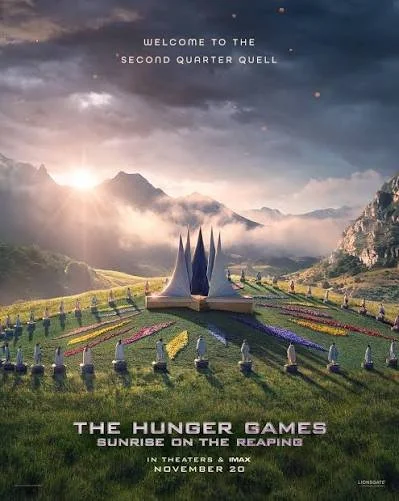
If your social media feed is anything like mine, Panem and its cast of characters have shown up a ton. Only recently, each of the movies revisited theaters. In about three weeks on November 20th, the latest installment hits the silver screen.
So many fans are getting wrapped up in the pomp and circumstance of the movies and its quite lovingly woven press tour. Genuine, real deal Hunger Games fan and confirmed Everlark shipper McKenna Grace has been throwing looks referencing everything from the movie’s settings to Katniss’s Catching Fire wedding dress and more. Her co-star Joseph Zada’s mannerism in red carpet interviews have become memes themselves. People ruminated on potential deliciously-in-poor-taste keepsake popcorn buckets, everything from a murderous gumdrop to an equally sinister squirrel.
The Hunger Games have always been a quite unique fandom. Saying you are looking forward to the new Hunger Games could so easily be misinterpreted in a horrifying way. So much of the books are about how storytelling and showmanship can be used to manipulate people, yet a part of the fandom’s fervor will always be about the surface (or seemingly surface) stuff—the memes, the beautiful gowns, the funny bits. It is a part of the whole picture, and if it was doom and gloom all the time people couldn’t listen. But there is so much else going on here.
I believe that The Hunger Games books are the most important books released in this century. It has a strong claim to the spot, at least. That a YA book and a piece of (gasp) genre fiction can grasp at that honor is quite the feat. The books are as intricate and well-woven as they are influential and talked about.
I am glad to see that The Hunger Games are quickly becoming a key part of both high school and college curriculums. I wonder how long it will be before a Norton Critical Edition? Less than twenty more years, I’d suspect, if Scholastic allows it. There are several teaching guides already on the market. I hope this love for The Hunger Games continues—that one day it is as ubiquitous as something like The Great Gatsby or Huckleberry Finn are. It has just as clearly telegraphed, essay-question-able symbols as they have. Maybe, one day, knowing what the flowers and the favorite colors in The Hunger Games mean will be as no-brainer as knowing what the green light means in Gatsby.
The books are in conversation with key parts of our past and present, both in a fictional sense and in terms of our actual history. Collins sprinkles references to Ancient Greece and Rome throughout. Stitched into all the books—but especially the two prequels—is a deep love for both song and poetry. The Ballad of Songbirds and Snakes has a deep relationship with the William Wordsworth poem “Lucy Gray,” and Sunrise on the Reaping has a similar symbiosis with “The Raven” by Edgar Allan Poe. When it comes to folksongs, both those cribbed from real life and ones Collins congers on her own, she shows a deep respect for how ballads can connect others and how they hide verboten messages in plain sight.
From Shakespeare’s Coriolanus to Thomas Hardy’s Far From the Maddening Crowd to Plutarch’s Parallel Lives, the series is in conversation with so many literary treasures—not to mention its ties to philosophy and political science. Reading the series alongside its influences could make for a great (and demanding) college course.
It feels odd to think that a series like this was so popular, that it held the imagination of my whole generation at one time, that it was so widely read and watched. The story is so violent and the world it inhabits is so bleak and unforgiving. Katniss is guarded to the point of being unlikeable to some. Haymitch’s life is thrown into a pit of despair. The Ballad of Songbirds and Snakes stars a pompous, entitled coward. Nothing about it screams “popcorn movie.”
There is something about the characters in these books, and the societies they inhabit that feel deeply real. ‘The Hunger Games’ are a humiliation ritual, a scare tactic, entertainment, and a declaration of ownership all at once. Everyone, from those pampered in the Capitol to the unfortunate child sacrifices, all feel so deeply desperate. There is so little compassion to go around, but little acts of kindness and connection are still present. People so discarded also read as so vivid.
The sickeningly sweet colors in the new Hunger Games arena, the poison paradise, are such an apt way to show how deceiving appearances can be. But that is only how things are when turned up to 11.
Everyone writes their own story and paints their own portrait of who they are. How you dress, how you spend your time, what you say and how you say it—all of it has an impact. Katniss took down the Capitol mostly with just a bouquet of flowers, a handful of berries, and a song. The three-finger salute starts out as a funerary tradition rather than a battle cry. For Katniss, even her most earnest words and gestures become propaganda for the rebels—who are not as innocent as they seem. In this world that says we need to keep talking, keep posting, keep promoting, keep dancing around, it is a good reminder of how much of that impulse is not quite right. But you can’t stop doing meaningful things either. There is no middle ground. Not acting is still an action.
In November, I will for certain go to see the new movie. The prequels feel special since the happy ending, er—bittersweet ending—, is in-universe decades and decades from coming to pass. Stories for young people aren’t supposed to end in defeat—that is so rare. So much of Haymitch’s life gets caught up in self-destruction and wasted potential. Katniss and Peeta are only marginally better off.
There are going to be tears and there are going to be thrills and there are going to be iconic lines. It will be difficult to see someone so earnest fail so spectacularly. Those who have read the trilogy but not the new book will discover whole new tragedies in this poor drunk’s life—some awful surprises.
But, eventually, it all works out. There is a new Spring day and there are new geese to cherish. It takes several more decades, but things are set right (or right enough) again. The Hunger Games can’t even outlast Snow’s lifetime.
If Haymitch got a bit less wrapped up in his technical goal and more into protecting the newcomers, maybe everything would be different. The beautiful, hideous distraction machine that is the Hunger Games ended up eating itself, because cameras were aimed at people who didn’t behave. People who refused to kill each other or view the death of another person as a small matter. And Snow had the idea of pointing the cameras so ardently in the first place, built his career on making the Hunger Games more key part of statecraft. He reaped what he sowed.
It is not 2008 anymore, or 2012. Teachers reading this alongside their high school students are working with kids about as old as the series itself is. Time has changed things. I am glad we have all collectively moved past the TeamGale and TeamPeeta debate, and that Peeta’s strengths as a character are properly respected. Katniss is a deeply private person and has hang-ups about romance due to her neglect as a child, there are bigger picture character reasons for the love triangle. No longer do we say “May the odds be ever in your favor,” to wish good luck for something as banal as a test or for a scratch-off.
But the media buzz feels similar. It is ok to want to watch the Hunger Games because they are made up. McKenna Grace reveled in wearing a dress that Katniss was forced to wear—and it looks great on her. She made lovey-dovey video edits of the best romantic moments in the movies, too, and that’s ok. The Hunger Games franchise is neither completely serious or completely silly. It could not survive along such absolute lines.
But that doesn’t mean it is vapid teenybopper nonsense. Things are seldom that simple, anyway. Things that capture the hearts and minds of so many people rarely are.
If you hustle, you can read the new book before the movie comes out. I ended up listening to the whole series in release order earlier this Summer through my Libby app, and that is also an option if you hurry. All of the characters and storylines feel more fleshed out years later.
Each of the Hunger Games books star a narrator who greatly influences what we know and how we know it, what we see and how it feels to us. Haymitch has a bit less of a pressing presence on his narrative as Katniss or Snow did, but he’s still there, adding his own spin to everything. In light of this, of course things will change. I hope I’ll have a nice time even if I end up liking the book better than the movie. It will be food for thought, at least.
I am wondering how they are going to incorporate ‘The Raven’ into the film? Maybe they aren’t going to? That would be a shame even if it is deemed necessary. A YA dystopia of all things helped me appreciate the difficult emotions within this classic piece of literature. It breathed new life into something I couldn’t quite access before.
If Collins writes about Panem again, I wonder what new piece of literature she will bring into the conversation and introduce millions of kids to? And what about the book itself? Maybe a book set in one of the more favored, more loyalist districts like District 1 or 2? There may be practical, completely understandable hurdles to writing an age appropriate Finnick book, even if so many fans want to know more about the character.
I wonder what Enobaria’s deal is….
And what sort of inevitable problems does this fledgling, vulnerable democracy face early on? Will we ever figure out what happened to the US prior to Panem and the districts?
So, what is your favorite symbol in the Hunger Games franchise? Mine is probably the pearl that Peeta gives Katniss in the Quarter Quell. But Buttercup the cat is a close second. What is your favorite intricate detail?
I wonder how much of Haymitch’s backstory and the 50th Hunger Games was already locked away in Collins’s mind when writing the original series and how much was built around the book’s current landscape after the fact? So many series include easter eggs that feel kitschy or like they are jumping up and down for attention, but here it felt genuine and honest.
So many questions, many of which can’t even be cracked at yet.
What is your favorite part of the world of Panem? Are you excited for the new movie?
